

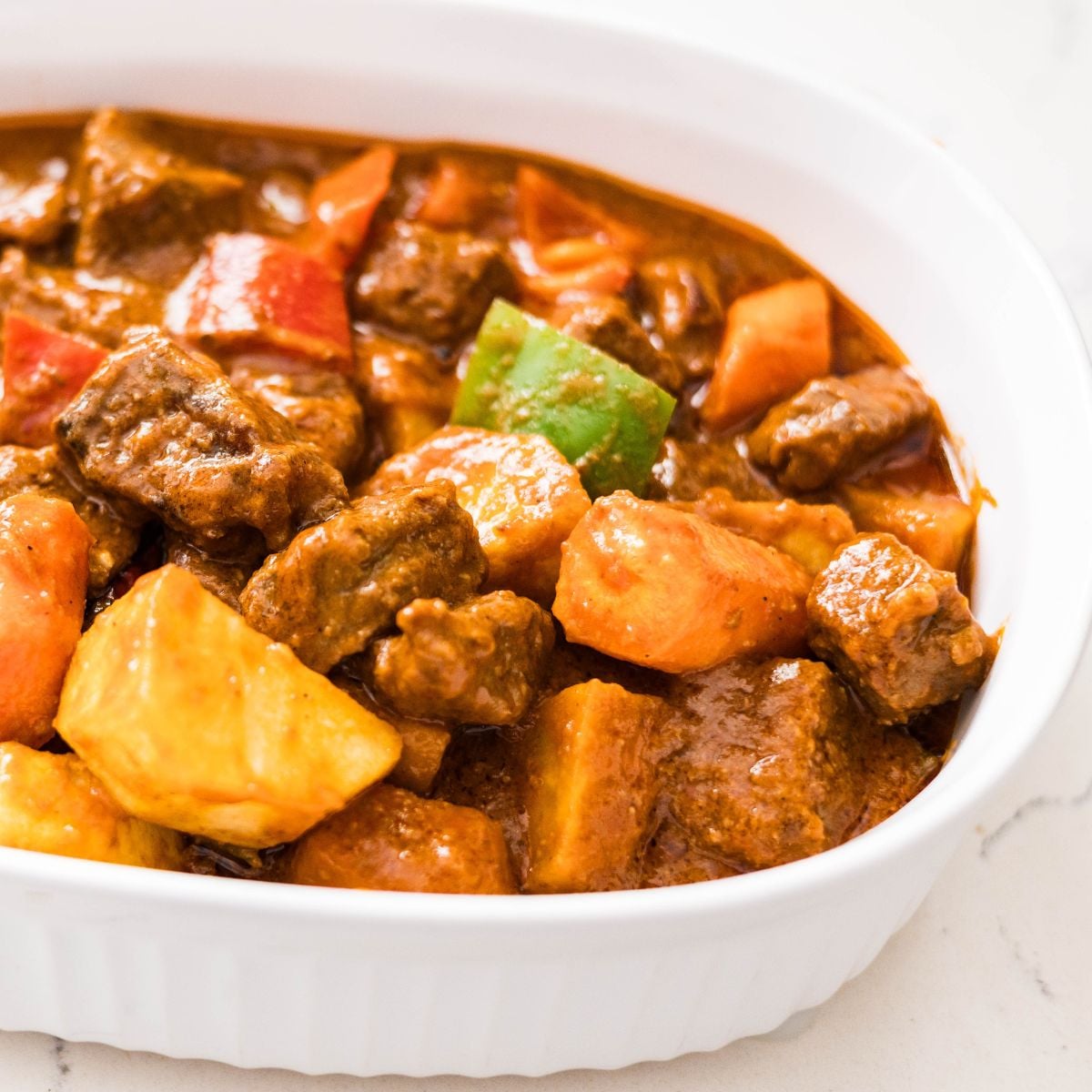
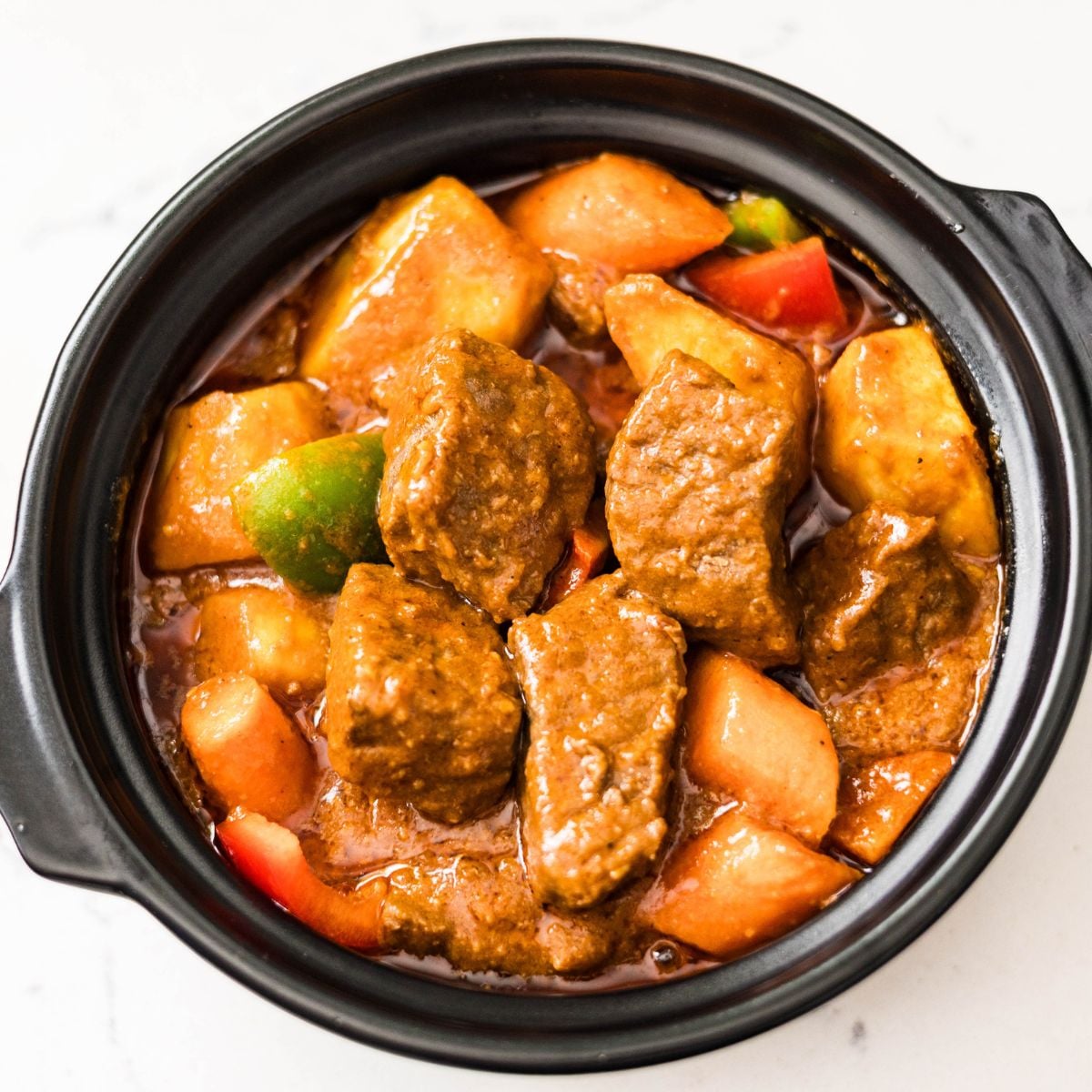
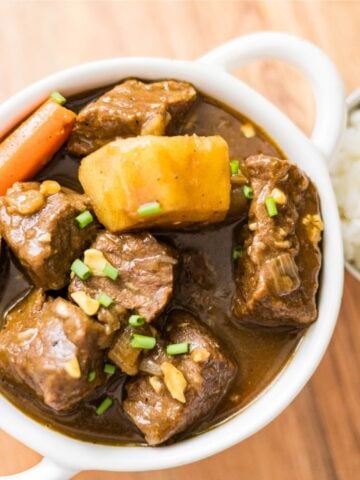
Caldereta is my favorite Filipino beef dish, second only to kare-kare. It shows up at every gathering I go to, and no two pots are ever the same.
Some people go heavy on the liver spread. Some skip the peanut butter. Some finish it with quick-melt cheese, some with cheddar. This is my version of beef caldereta with cheese, built around the part that actually matters: the sauce. It should be thick enough to coat every piece of beef, savory, and just creamy enough to cling to rice.
Save This Recipe 💌
Two things get it there. Frying the potatoes and carrots before they go anywhere near the sauce keeps them from breaking down over a long simmer. And the cheese goes in off the heat rather than in it, so it melts smooth instead of turning grainy.
The marinade is optional and I usually skip it. When I do have time, it's soy sauce and calamansi for an hour or so, which brightens the beef a little at the edges. But most nights the pot goes on without it. Browning the beef and simmering it straight in the sauce builds plenty of flavor on its own, and it saves you the wait.
About 2 ½ hours start to finish, most of it hands-off, and it tastes better the next day. If you want something faster on a weeknight, my easy beef pares is the one I fall back on.
Jump to:
- What Is Beef Caldereta?
- Why You'll Love This Recipe
- Ingredients
- Which Cheese to Use for Caldereta
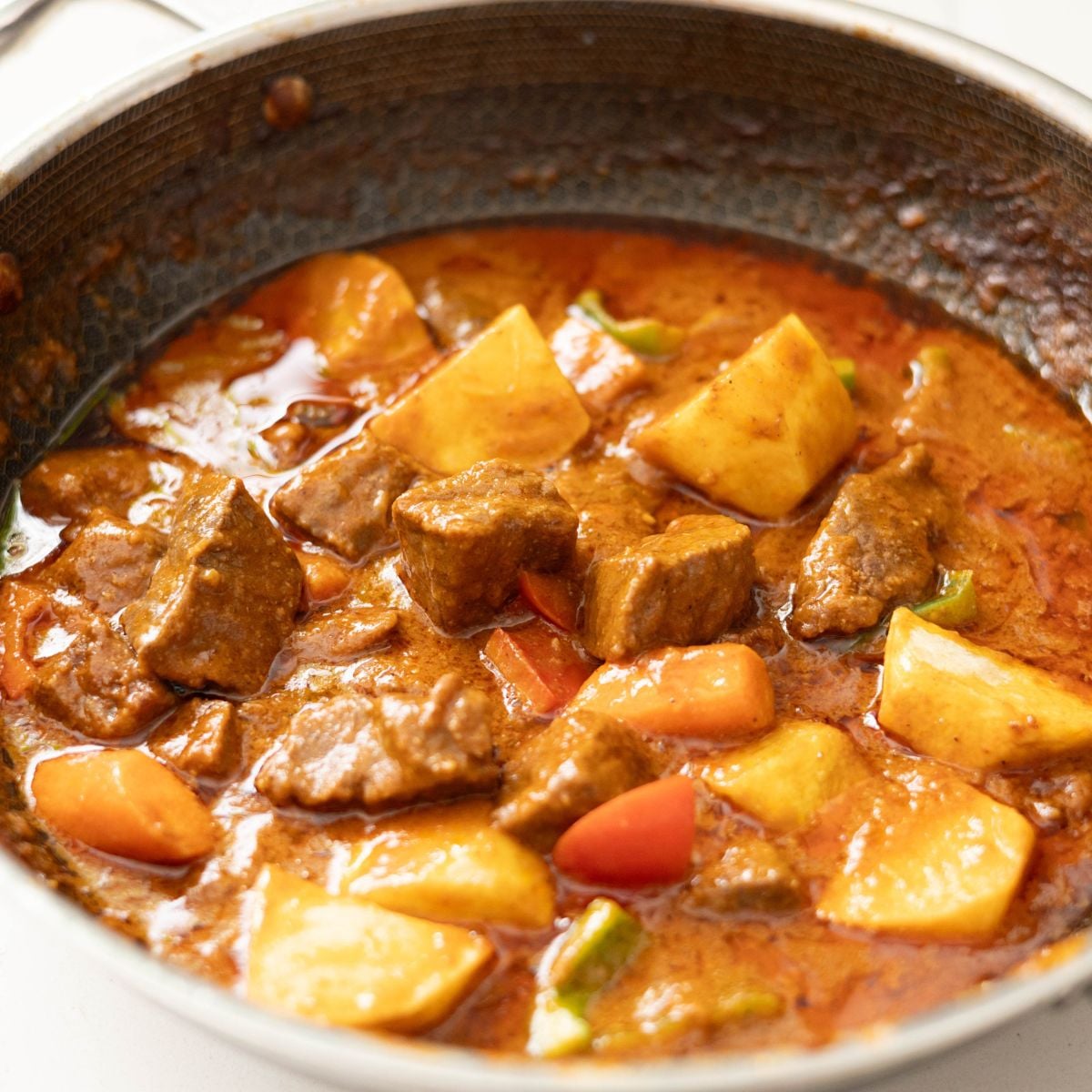
- How To Make Beef Caldereta with Cheese
- Slow Cooker and Instant Pot Caldereta
- Rose's Top Tips
- Variations
- What to Serve With Beef Caldereta
- Storage and Reheating
- Recipe FAQs
- More Filipino Beef Recipes You'll Love
- Did you try this recipe?
- Beef Caldereta with Cheese (Kalderetang Baka)
What Is Beef Caldereta?
Beef caldereta is a Filipino beef stew made with tender beef, tomato sauce, potatoes, carrots, and bell peppers. The name comes from the Spanish caldera, meaning cauldron, and the dish was originally made with goat. Beef took over in most households because it's easier to find, though kalderetang kambing is still what gets cooked at town fiestas in a lot of provinces.
Liver spread is one of the ingredients that commonly distinguishes caldereta from other Filipino tomato-based stews. Filipino cooking has a whole family of tomato-based stews that look similar at a glance: mechado, afritada, menudo. Same vegetables, same tomato base. Caldereta is the one with liver spread in the sauce, which is where that deeper, slightly earthy flavor comes from.
From there, cooks build it out differently. Peanut butter makes the sauce richer and thicker. Cheddar melts in at the end for a creamy finish. Some regions add green olives, some use peanut butter in place of the liver spread entirely.
It's the kind of dish people make for Sundays, holidays, and family gatherings. And yes, it's best with rice.
Why You'll Love This Recipe
- Rich and deeply savory - Tomato sauce layered with liver spread, peanut butter, and melted cheese. Nothing thin or one-note about it.
- About 2 ½ hours, mostly hands-off - Roughly 30 minutes of actual work. The rest is the pot doing its thing while you're somewhere else.
- Tender beef every time - Low and slow braising does all the work. You just need patience.
- Better the next day - The sauce thickens and the flavors settle as it sits, which makes it a solid make-ahead for a gathering.
- Feeds a crowd - This makes a generous pot. Serve it over rice and it stretches a long way.
- Flexible - Beef chuck, short ribs, or stew meat. Any well-marbled cut works.
Ingredients
Here's what you'll need:
- Beef chuck or short ribs is the move. You want a cut with enough marbling to break down over the long simmer. Lean beef will turn dry and tough. Bone-in short ribs add extra richness to the sauce, but boneless chuck is easier to eat and works just as well.
- Liver spread is what makes this caldereta and not mechado or afritada. It adds an earthy, savory depth you can't get any other way, and it thickens the sauce as it dissolves. For this version, I don't recommend skipping it. If you're worried it will taste like liver, it won't. It reads as depth, not organ meat.
- Peanut butter adds body and a subtle nuttiness to the sauce. It sounds unusual until you taste it. Use plain, creamy peanut butter if you have it, but Skippy or Jif works.
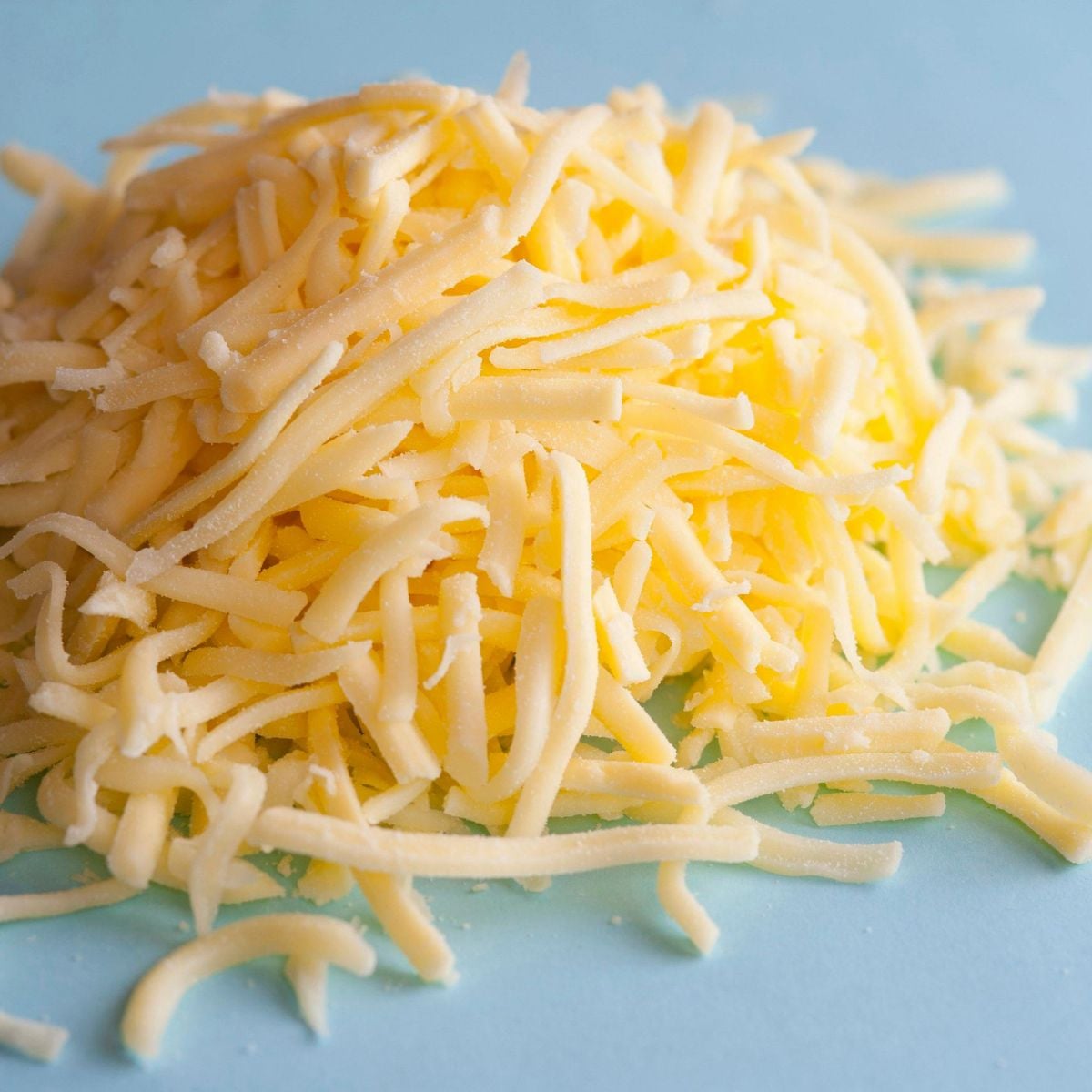
- Cheddar cheese goes in at the very end and melts into the sauce, making it thicker and slightly creamy. Shred it yourself. Pre-shredded cheese contains anti-caking agents that can make it melt less smoothly.
- Tomato paste is worth stirring directly into the beef before adding any liquid. Cooking it in the fat for about a minute deepens the flavor and takes off the raw, tinny edge.
- Oyster sauce isn't in most caldereta recipes and I add it anyway. It brings a savory, slightly sweet backbone that keeps the tomato from dominating. Leave it out if you don't have it and the dish is still fine, just a little flatter.
- Potatoes and carrots get fried before they go in the pot. This is the difference between vegetables that hold their shape after two hours and vegetables that fall apart into the sauce.
See recipe card for quantities.
Substitutions and Additions
Substitutions
- No liver spread? Chicken liver pâté works, or blend a small piece of cooked chicken liver until smooth and stir it in. Start with less than you think, taste, and add more. The flavor won't be identical but it fills the same role in the sauce. Some regions skip it entirely and lean on peanut butter instead, which is a real regional version rather than a compromise.
- No peanut butter? You can leave it out. The sauce will be thinner and less nutty, so simmer it a few minutes longer to make up the body. For a peanut allergy, a small amount of tahini gets you close on texture, though the flavor goes in a different direction.
- No oyster sauce? Skip it, or use a little extra soy sauce plus a pinch of sugar. You lose some savory depth but nothing structural.
- No calamansi for the optional marinade? Lemon, or a mix of lemon and lime, is the closest. Regular lime alone is sharper than calamansi and worth cutting with a little lemon.
- Beef cut swaps. Chuck, short ribs, brisket, or stew meat all work. Anything well marbled with connective tissue. Skip lean cuts like sirloin, which go dry over a long braise no matter how low the heat.
- Cheese swaps. Covered in the cheese section below, but the short version: quick-melt or cheddar both work and they behave differently.
Additions
- Green olives. Pitted green olives go in with the bell peppers. They add a briny edge that cuts the richness. Common in a lot of family versions and worth trying if you like that contrast.
- Green peas. Stir in frozen peas in the last few minutes, just long enough to heat through. Mostly for color and a little sweetness.
- More heat. Add extra Thai chili or a full teaspoon of chili flakes. The heat builds the longer it simmers, so go easier than you think at the start and adjust at the end.
- Bay leaf and a splash of vinegar. A tablespoon of vinegar added with the tomato sauce brightens things up if your sauce tastes heavy. Let it simmer at least 20 minutes after so the raw edge cooks off.
Which Cheese to Use for Caldereta
Cheddar and quick-melt both work, and they don't do the same thing.
Quick-melt is what most Filipino households reach for. Eden, Magnolia, that style of processed cheese in blocks. It's mild and it disappears into the sauce, so you get body and creaminess rather than cheese flavor. If you grew up eating caldereta at gatherings, that's the texture you remember.
Sharp cheddar melts less smoothly and actually tastes like cheese, which gives the sauce a tangier edge. Either way, shred it yourself. Pre-shredded is coated in anti-caking agents that keep it from melting cleanly, and that's most of the difference between a smooth sauce and a grainy one.
Then turn the heat off before it goes in. Cheese breaks when it gets too hot, which is when the sauce turns grainy or the fat separates. Off the heat it melts in smooth and thickens as it goes.
Start with less than you want. You can stir in more, but you can't take it back out.
How To Make Beef Caldereta with Cheese
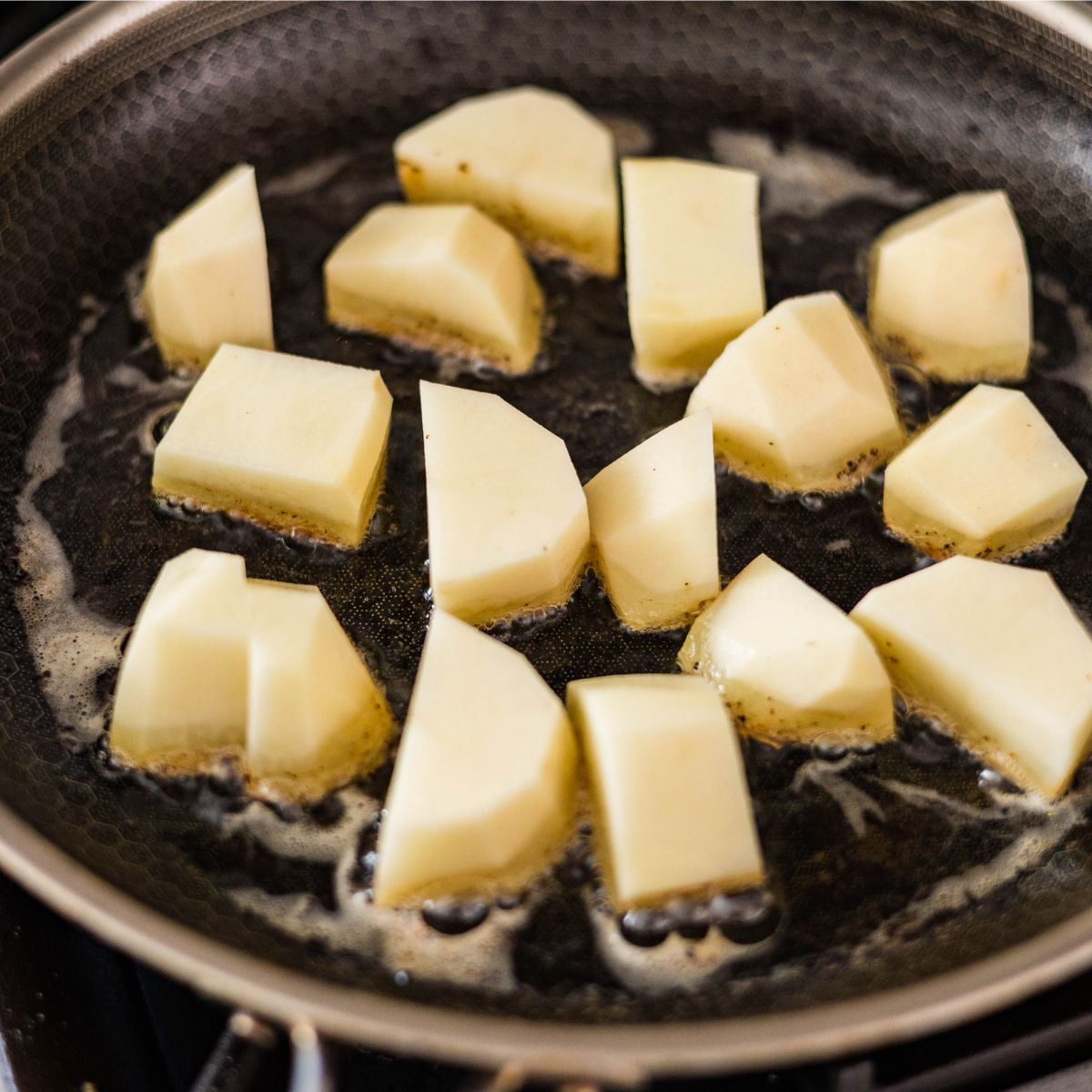
- Fry the potatoes and carrots - Heat oil in a large pot over medium heat. Fry the potato chunks and carrots until lightly golden at the edges. They don't need to be cooked through. Remove and set aside. This is what keeps them from falling apart later.
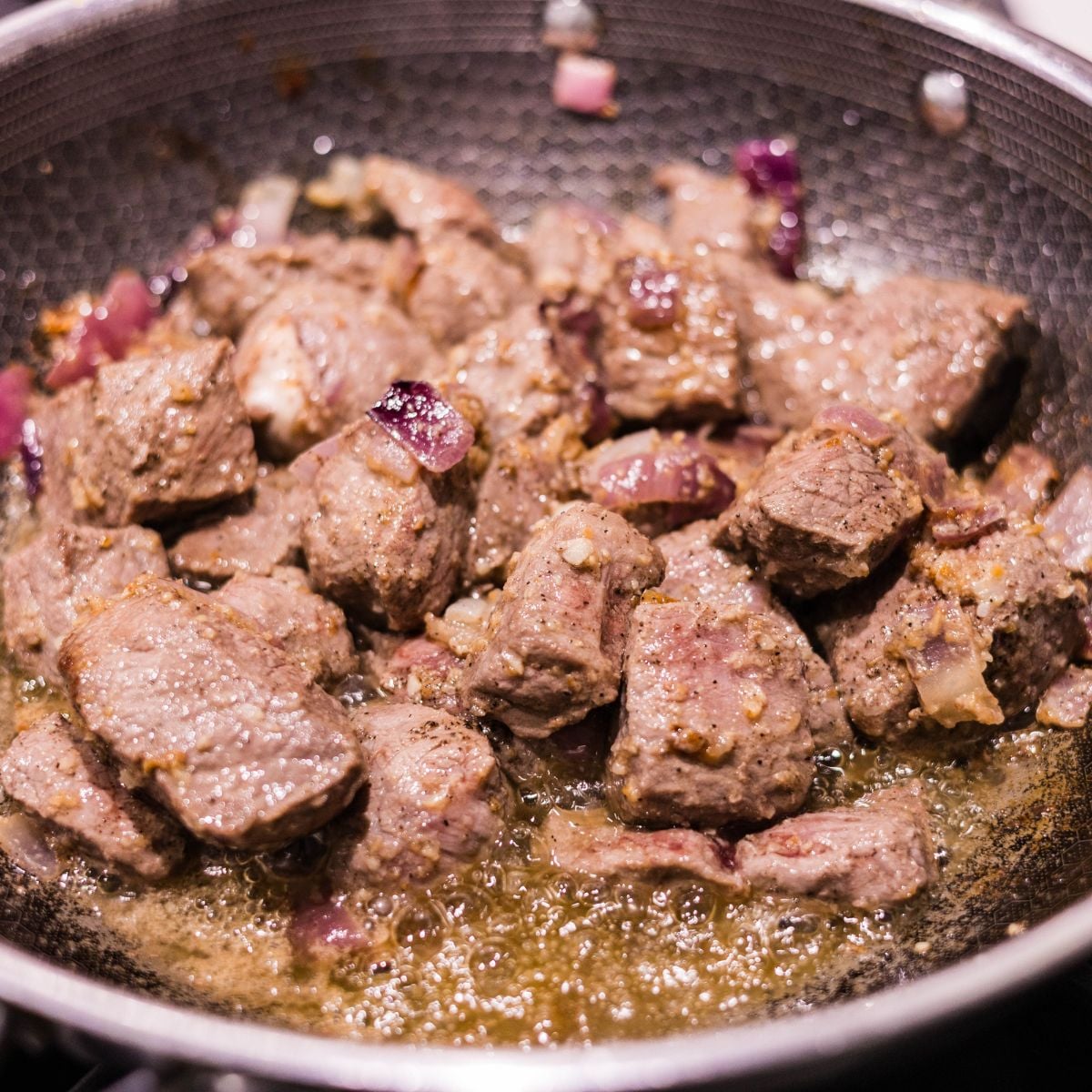
- Sauté the aromatics and brown the beef - In the same pot, cook the onion until softened, then add the garlic and cook until fragrant. Add the beef, season lightly with salt and pepper, and brown on all sides. Work in batches if the pot looks crowded, since beef that steams instead of browning costs you flavor in the sauce.
- Build the sauce and simmer - Stir in the tomato paste and cook about 1 minute. Pour in the tomato sauce and water, then add the beef powder, soy sauce, oyster sauce, bay leaves, sugar if using, and chili flakes or Thai chili for heat. Scrape up the browned bits from the bottom. Cover and simmer on low for 1 ½ to 2 hours, until the beef is fork-tender. Keep it at a low simmer, not a boil, or the meat tightens up instead of relaxing.
- Stir in the liver spread and peanut butter, then the vegetables - Once the beef is tender, stir in the liver spread and peanut butter until fully dissolved into the sauce. Add the fried potatoes and carrots back in and simmer 10 to 15 minutes, until tender.
- Finish with bell peppers and cheese - Stir in the red and green bell peppers and cook 3 to 5 minutes, just until slightly tender. Turn off the heat, then stir in the shredded cheddar until melted. Taste, adjust seasoning, and serve hot with rice.
Slow Cooker and Instant Pot Caldereta
Both work. You still brown the beef first and you still finish with the cheese off the heat.
Instant Pot
Brown the beef on sauté, then build the sauce in the pot. Pressure cook on high for 35 to 40 minutes with a natural release. Switch back to sauté, stir in the liver spread and peanut butter, add the fried potatoes and carrots, and simmer 10 to 15 minutes. Peppers, then cheese with the pot off.
Slow Cooker
Brown the beef in a pan first, then transfer to the slow cooker with the sauce. Cook on low for 6 to 8 hours or high for 3 to 4. Add the fried potatoes and carrots in the last hour so they don't turn to mush. Stir in the liver spread and peanut butter near the end, then the peppers, then the cheese with the cooker turned off.
Skip browning in either method and the sauce comes out noticeably flatter. It's ten minutes and it's the difference.
Rose's Top Tips
- Fry the potatoes and carrots first. The browned surface holds up over a two-hour simmer. Raw vegetables go in soft and come out as sauce.
- Don't crowd the pot when you brown the beef. Too much meat at once drops the heat and the beef steams in its own liquid instead of searing. Two batches takes five extra minutes and it's where a lot of the sauce flavor comes from.
- Cook the tomato paste before adding liquid. About a minute in the hot fat. It takes off the raw, tinny edge and deepens the color of the sauce.
- Keep it at a low simmer, not a boil. Boiling tightens the muscle fiber and the beef gets tougher before it gets tender. You want lazy bubbles, not a rolling pot.
- Taste before the cheese, not after. The cheese adds salt and richness, so a sauce that's already seasoned right will end up over-salted. Season it slightly under and let the cheese close the gap.
- Make it a day ahead. The sauce thickens and the flavors settle overnight. Reheat gently with a splash of water to loosen it back up.
Variations
- Kalderetang kambing (goat caldereta) - The original, and still what gets cooked at town fiestas in a lot of provinces. Goat has a stronger, gamier flavor that stands up well to the tomato and cheese. Same method, same timing, just swap in goat cut into chunks.
- Pork caldereta - Pork shoulder or ribs instead of beef. Shorter simmer since pork tenderizes faster, about 45 minutes to an hour.
- Chicken caldereta - Bone-in thighs work best. Cook time drops to around 30 to 40 minutes.
- Spicy caldereta - More Thai chili or a full teaspoon of chili flakes. Add it early and taste at the end, since the heat builds over a long simmer.
- Batangas-style - Worcestershire sauce and a spoonful of sweet pickle relish alongside the usual sauce. It reads sweeter and tangier than the standard version. A regional take worth knowing if you've had caldereta that tasted different from yours and couldn't place why.
What to Serve With Beef Caldereta
- Steamed white rice is the real answer. The sauce is built for it. Serve more sauce than feels reasonable, because it gets absorbed fast.
- Garlic fried rice - For leftovers, especially. Reheated caldereta over sinangag is better than the first night in my opinion, and the garlic gives the sauce something to push against.
- Atchara - Pickled green papaya, sharp and a little sweet. A spoonful on the side cuts the richness of the sauce, which matters more than it sounds like it should when the whole dish is this heavy.
- Something green and plain. Blanched sitaw, sautéed bok choy, even a plain cucumber salad. The plate is all soft and rich otherwise, and one crisp thing changes how much of it you can eat.
- Crusty bread - Not traditional, but the sauce is worth mopping up and pandesal or a baguette both do the job.
Storage and Reheating
Store leftover caldereta in an airtight container in the fridge for up to 4 days. The sauce will set up thick as it chills, which is normal.
To reheat, warm it gently on the stove over low heat with a splash of water or broth to loosen it. Keep the heat low and stir now and then. The cheese and peanut butter in the sauce will separate if you push it too hard, the same way they would if you'd added the cheese over high heat in the first place.
To freeze, cool completely and freeze in portions for up to 3 months. Thaw overnight in the fridge and reheat the same way. The potatoes soften more after freezing, so if you're making a batch specifically to freeze, leave them out and add fresh fried potatoes when you reheat.
Recipe FAQs
Beef chuck. It has enough fat and connective tissue to go tender over a long braise without drying out. Bone-in short ribs are the other strong option and add more richness to the sauce. Skip lean cuts like sirloin, which tighten up and stay dry no matter how long you cook them.
A canned, spreadable pâté used across Filipino cooking. CDO and Argentina are the common brands. Look in Filipino grocery stores, most Asian supermarkets, or order it online. It's cheap and it's the ingredient that makes this caldereta rather than mechado or afritada.
No. It dissolves completely into the tomato sauce and reads as savory depth, not organ meat. If you've eaten caldereta at a Filipino gathering, you've had it without noticing. Start with the amount in the recipe and you won't taste it as liver.
The cheese went in too hot, or it was pre-shredded. Turn the heat off completely before the cheese goes in, and shred your own so there's no anti-caking coating to fight. If it's already grainy, a splash of water and gentle stirring off the heat helps some, though it won't fully come back.
Simmer uncovered for another 10 to 15 minutes. Also check that the liver spread and peanut butter are fully dissolved, since both thicken the sauce as they break down. The cheese tightens it a little more at the end.
Yes, and it's better that way. Cook it fully a day ahead, hold the cheese, and refrigerate. Reheat gently the next day and stir the cheese in off the heat right before serving. The sauce thickens overnight and the flavors settle.
More Filipino Beef Recipes You'll Love

Did you try this recipe?
Share how it turned out in the comment box below, and if you loved it, share it on Facebook, Pinterest & Instagram.
Thank you!

Beef Caldereta with Cheese (Kalderetang Baka)
Equipment
- Large pot or Dutch oven
Ingredients
- 2 pounds beef chuck short ribs, or stew meat, cut into chunks
- 2 tablespoons oil
- 1 small onion chopped
- 1 head garlic minced
- 1 cup tomato sauce
- 2 tablespoons tomato paste
- 2 cups water
- 1 tablespoon beef powder
- 1 tablespoon liver spread
- 2 tablespoons peanut butter
- 2 tablespoons soy sauce
- 1 tablespoon oyster sauce optional but recommended
- 1 to 2 bay leaves
- 1 teaspoon sugar optional
- 1 teaspoon chili flakes or 3 chopped Thai chili optional
- Salt and pepper to taste
Vegetables
- 2 potatoes cut into big chunks
- 2 carrots cut into chunks
- 1 red bell pepper sliced
- 1 green bell pepper sliced
Finish
- ½ cup shredded cheddar cheese
Instructions
- Fry the vegetables. Heat the oil in a large pot over medium heat. Fry the potatoes and carrots until lightly golden on the edges. They do not need to be fully cooked. Remove from the pot and set aside.2 tablespoons oil, 2 potatoes, 2 carrots
- Sauté the aromatics. In the same pot, sauté the onion until softened. Add the minced garlic and cook until fragrant.1 small onion, 1 head garlic
- Brown the beef. Add the beef chunks to the pot. Season lightly with salt and pepper, then cook until the beef is lightly browned.2 pounds beef chuck, Salt and pepper
- Build the sauce. Add the tomato paste and stir it into the beef for about 1 minute. Pour in the tomato sauce and water. Add the beef powder, soy sauce, oyster sauce if using, bay leaves, sugar if using, and chili flakes or Thai chili if using. Stir well.1 cup tomato sauce, 2 cups water, 1 tablespoon beef powder, 2 tablespoons soy sauce, 1 tablespoon oyster sauce, 1 to 2 bay leaves, 1 teaspoon sugar, 1 teaspoon chili flakes or 3 chopped Thai chili, 2 tablespoons tomato paste
- Simmer the beef. Cover and simmer over low heat for 1 ½ to 2 hours, or until the beef is tender. Stir occasionally and add a little more water if the sauce gets too thick before the beef softens.
- Add richness. Stir in the liver spread and peanut butter until fully melted into the sauce.1 tablespoon liver spread, 2 tablespoons peanut butter
- Return the vegetables. Add the fried potatoes, carrots, and bell pepper back into the pot. Simmer for 10 to 15 minutes, or until the vegetables are tender.2 potatoes, 2 carrots, 1 red bell pepper, 1 green bell pepper
- Finish with cheese. Turn off the heat or lower it to the lowest setting. Stir in the shredded cheddar cheese until melted into the sauce. Taste and adjust with salt, pepper, or a little sugar if needed.½ cup shredded cheddar cheese
- Serve. Serve hot with steamed white rice.
Save This Recipe 💌
Notes
- Frying the potatoes and carrots first helps them hold their shape so they do not fall apart in the stew.
- Use beef chuck, short ribs, or stew meat with good marbling. Lean cuts like sirloin can turn dry after a long simmer.
- Do not rush the simmer. Low and slow cooking is what makes the beef tender and the sauce rich.
- Cook the tomato paste for about 1 minute before adding liquid to deepen the flavor and remove the raw tomato taste.
- Add the cheese at the very end, off the heat or on very low heat, so the sauce stays smooth and does not turn grainy.
- For a spicier kaldereta, use Thai chili or increase the chili flakes.
- If the sauce is too thick before the beef is tender, add a splash of water and continue simmering.
- If the sauce is too thin, simmer uncovered for 10 to 15 minutes to reduce.
- Kaldereta tastes even better the next day as the sauce thickens and the flavors deepen.
- Store leftovers in an airtight container in the refrigerator for up to 4 days.
- To freeze, cool completely and portion into freezer-safe containers or bags. Freeze for up to 3 months.
- Reheat gently on the stove over medium-low heat. Add a splash of water or broth to loosen the sauce.

Rose Sioson says
Stir the liver spread in toward the end of cooking. It thickens the sauce fast and can stick to the pot if it simmers too long.