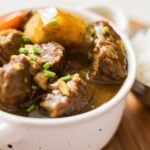
Japanese Beef Curry
Japanese beef curry made with store-bought curry roux, beef chuck simmered until tender, and potatoes fried first so they hold their shape. One pot, about 90 minutes, spooned over short-grain rice.
Servings: 6 people
Calories: 575kcal
Equipment
- Large pot or Dutch oven
Ingredients
- 2 pounds beef chuck cut into 1½-inch cubes
- 2 tablespoons neutral oil divided
- 1 large yellow onion chopped
- 6 cloves garlic minced
- 1 teaspoon grated ginger
- 2 medium carrots cut into chunks
- 2 medium Yukon Gold potatoes cut into chunks
- 4 cups beef broth or water
- 1 small apple peeled and grated, optional
- 1 teaspoon Worcestershire sauce
- 1 tablespoon ketchup
- 1 teaspoon salt
- ½ teaspoon ground black pepper
- ½ box Japanese curry roux
For Serving
- Cooked Japanese short-grain rice
- Fukujinzuke or pickled ginger optional
Instructions
- Heat the oil in a large pot or Dutch oven over medium heat. Add the potato chunks and fry until lightly golden on the outside, 8 to 10 minutes. They do not need to be cooked through. Remove and set aside.
- Pat the beef dry and season with salt and pepper. Raise the heat to medium-high and brown the pieces in batches, 3 to 4 minutes per batch, without crowding the pot. Set aside.
- Lower the heat to medium. Add the onions and cook 8 to 10 minutes, stirring occasionally, until soft and lightly golden. Add the garlic and ginger and cook 1 minute more, until fragrant.
- Break the curry roux into pieces and add to the pot. Stir over low heat until it softens and coats the onions, about 2 minutes. Keep the heat low so it doesn't scorch.
- Return the beef and any juices to the pot, stirring to coat. Pour in the beef broth slowly, stirring as you go, until the roux dissolves smoothly. Add the grated apple, Worcestershire sauce, and ketchup.
- Bring to a gentle boil, then reduce the heat, cover, and simmer 45 to 60 minutes, until the beef gives easily when pressed with a spoon. Stir every 15 minutes and scrape along the bottom of the pot. Add a splash of broth if the sauce reduces too far.
- Add the carrots and simmer 10 minutes. Add the fried potatoes and cook 5 minutes more, until both are tender. Skim any fat from the surface.
- Remove from the heat and let the curry rest 10 minutes before serving. Serve over Japanese short-grain rice with fukujinzuke or pickled ginger.
- Remove from the heat and let the curry rest 10 minutes before serving. Serve over Japanese short-grain rice with fukujinzuke or pickled ginger.
Notes
Curry roux. Half a box, about 3.2 to 3.5 ounces, is right for 4 cups of liquid. Box sizes and block counts vary by brand, so check the back before measuring. S&B Golden Curry is more savory, Vermont Curry is milder and sweeter, and Java Curry sits between them. Half a box each of two brands gives more depth than either alone.
Roux timing. This recipe melts the roux into the onions before the liquid goes in, which gives the sauce a deeper, toasted flavor. It also means the roux sits in the pot through the simmer, so keep the heat low in step 4 and scrape the bottom when you stir in step 6. If you prefer, dissolve the roux in a ladle of hot broth and stir it in during the last 10 minutes instead.
Beef. Buy chuck as a roast and cut it into 1½-inch pieces yourself rather than using pre-cut stew meat, which is often a mix of scraps that cook unevenly. Brisket or beef shank also work. If the beef is still tough after an hour, it needs more time, not more heat. Cover and give it another 15 to 20 minutes at a gentle simmer.
Potatoes. Frying them first is what keeps them from breaking down into the sauce. Yukon Gold holds up best. Russets fall apart faster, so cut them larger if that's what you have.
Sauce consistency. The sauce thickens as it cooks and again as it cools, so pull it slightly looser than you want it on the plate. Too thick, add hot broth a little at a time. Too thin, simmer uncovered a few minutes longer.
Lumps. These come from adding the broth too fast. Pour it in stages and stir between each addition.
Storage. Airtight in the fridge up to 4 days, rice stored separately. Freezes up to 3 months, though the fried potatoes soften after thawing. If you plan to freeze a batch, leave the potatoes out and add fresh ones on reheating. This tastes better on day two.
Leftovers. Thin with broth over udon noodles, or stir into day-old rice in a hot wok for curry fried rice.
Nutrition
Calories: 575kcal | Carbohydrates: 30g | Protein: 35g | Fat: 33g | Saturated Fat: 12g | Cholesterol: 110mg | Sodium: 1120mg | Potassium: 860mg
